About Me

My photo
Recent retiree--35 year's experience teaching reading, English, adult basic education and volunteer leadership skills. Started this blog to exchange ideas and commentary with friends and others having an interest in joining the discussions. Greatest life accomplishments include: 1.organized my 3rd grade class to check out library books for me to get around librarian's weekly limit--Amazon.com, the Mullins Elementary 3rd Grade Class of 1956 is still waiting for "thank you" notes; 2. volunteered in the Peace Corps, island of St. Kitts, West Indies; 3.taught adults to read, earn their GEDs., and speak English as a second language; 4. bought a border collie puppy for $6, got evicted rather than give him up, and began a life-long love affair with all things "Dog"; 5. joined a physical fitness boot camp in my mid-50s--don't mess with someone who's been doing regulation pushups in wet grass at 5:30 a.m.; 6. walked across Northern England with best friend Sally--over 80 miles from the Irish to North Seas; and 7. travelled to many foreign countries for pleasure and work.

Sunday, June 26, 2011

English Gardens Travelogue, cont. - Countryside, Castles and Estate Gardens


Here's leg three of my 1993 tour of some of the best public and private gardens in England. Reader alert! I'm probably overestimating your interest in English gardens, even though they are quite beautiful. If so, just scroll through all these photos and stop where one catches your fancy. In a previous post on blogging "rules", I mentioned that some posts I wrote specifically for my readers; others I wrote because there were stories I wanted to have in writing. This travel post is mostly for my benefit, but I hope some of you enjoy the journey as well. (Photo above left--Leeds Castle and surrounding moat, County Kent)

So, after several days in London about 25 enthusiastic gardeners loaded on the Horticulture tour bus and headed south east toward County Kent. Much of the drive was through rural agricultural countryside. From my perch in the back of the bus--the peanut gallery as those of us called it who chose to ride there where the conversation was livelier and more friendly--we had our first glimpses of rural England, including:

This vista of farm fields with hedgerow patchworks--not quite as obvious as in Ireland, but still the fence of choice:

This is a field of rape with it's yellow mustard-like blooms. Grown mostly for cooking(rapeseed and canola)oils, diesel fuel, and animal feed. Notice the road signs--perfectly adequate for low traffic driving:

Furture south we begin to see rolling hills dotted with sheep as we get closer to the Cotswolds:

This is an oast house, a popular form of architecture. These now private homes or bed and breakfasts used to be hop kilns with several floors for drying hops for ale and beer making. The conical roof allowed for air circulating so that the hops would dry, not mold:

The tour bus went through several small villages with streets so narrow that you could almost reach out the bus window and touch the buildings. Notice the thatched roofs:

In May many of the village shops were gaily decorated with flowering pots, the taller ones on pulleys that could be raised for ease in watering:

And, in the days before cell phones, the iconic red telephone booths from which to make a quick call while in the village doing your errands:

Southern England has used thatching for roof (bundles of straw, wheat, reeds) for many centuries. As the thatch wears, new material is just laid over the old, much like we do with asbestos roofing. Doesn't this cottage look like it belongs on a movie set?
Notice the graceful flow of this roof line (many different shapes). This was the cottage of one of the gardeners whom we visited:
Over a time the roofs may blacken from wood smoke like this one. I love the way ivy, vines and some young trees were trained to grow up the sides of the cottages:


Our first major stop in southern England was Leeds Castle in Kent. In May the castle grounds were abloom with many varieties of azaleas and rhododendrons. This castle was built in the 1100s and now expanded to include a yew maze, grotto, formal gardens, and vineyard:


Most peculiar sight was the Dog Collar Museum in the castle. Over 100 collars in the collection from medieval to Victorian times. The collars exhibited were fearsome metal and leather things studded with spikes to protect the necks of hunting dogs. Shudders!

This was the caretaker's cottage on the main drive to the castle--notice thatched roof. Nice digs if you can get 'em!

Formal walkway leading to the Culpepper House. Just imagining the amount of clipping required to keep these precisely trimmed hedges:

This was a view of the roofline of the estate house from the Culpepper Garden. This garden was designed by an American, Russell Boyd who is not only a garden designer but an artist. The garden was a series of box-edged "rooms" filled with flowering perennials, bulbs, and shrubs, all in a pink, white, burgundy color scheme. The whole garden was just filled with ideas I wanted to remember and try at home--lots of photos this day:


The castle grounds was in the middle of some beautiful country fields so Boyd included these vistas in his garden design:

Another example of Boyd's artist's eye in combining plant textures and colors:

A closeup of his color scheme--only plant I know for sure is the lupines in center:

An unexpected pleasure had to be the aviary on the grounds--over 100 species of rare and colorful birds, including macaws, cocatoos, and toucans. Surprisingly the birds had a great deal of freedom:

Black swans:

A mystery breed of duck. Can anyone tell me what this beauty is--Muscovy or wood, perhaps?
And, of course any aviary would need Mr. Peacock:

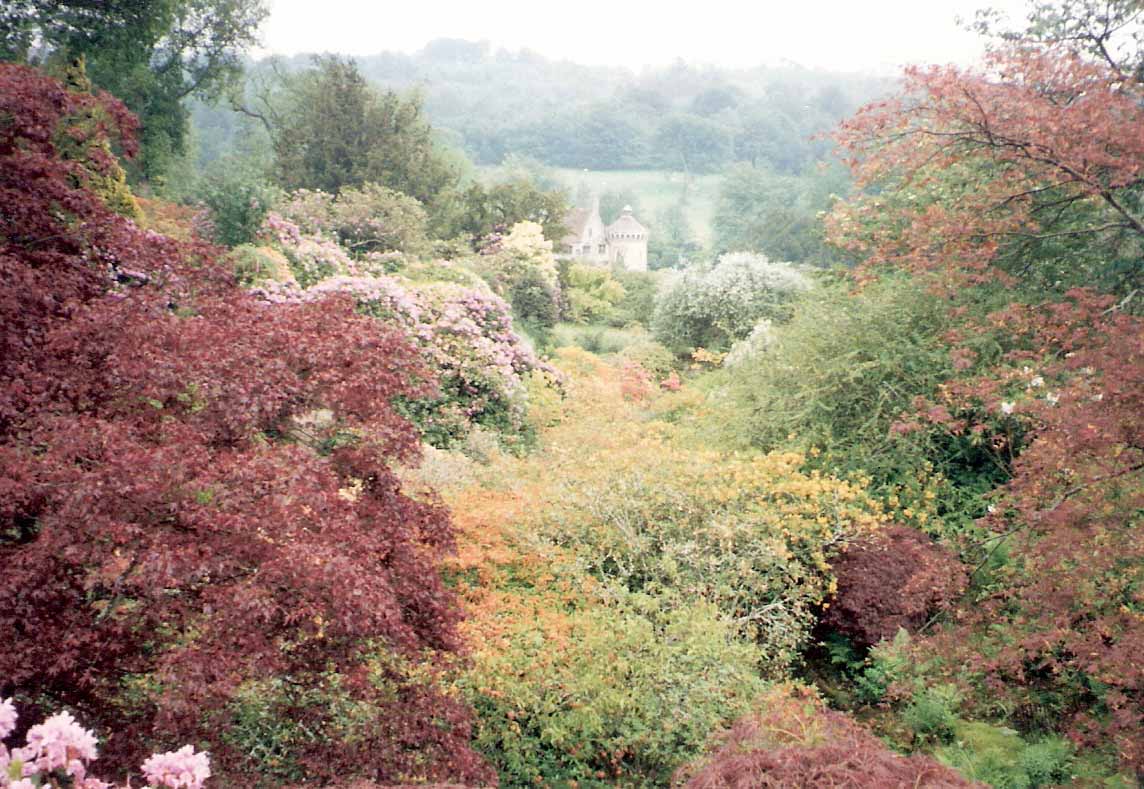
After leaving Leeds we traveled to Scotney Castle Garden in East Sussex. We arrived to a misting rain which was perfect for this place. This was the view from the quarry walking downhill to the castle. What a riot of color--all deliberately planned plantings:


Scotney Castle, also built in the 1100s, is surrounded by a lily moat which, with the overcast sky, reflected the rust and grey of the castle ruins, the sky, and trees:

Garden beds inside the castle ruins:

Walking along the moat path I spotted this little thatched "house" at the water's edge. Shelter for water fowl, perhaps? The large-leaved plant is gunnera:

After Scotney, we drove on to Rye and the Mermaid Inn for our next three night's stay. This inn was over a 100 year's old:

Out my room's window spotted these clay cats on the slate roof. Must keep your eyes open when traveling, always surprises!

Well, this tour is not over. If your eyes are not totally crossed, come back later in the week for visits to Great Dixter and Sissinghurst.

Thursday, June 23, 2011

Celebrating @ Summit Musings - 300th Blog Post!


Hey out there! Have some virtual chocolate to help celebrate a significant day for me in the blogosphere. Since May 2007 when, with a lot of excitement and self-doubting, I got on Blogger and set up my own web page, I've sat down at my computer on a regular basis to crank out posts or "musings" about living the good life as a retiree. This post is the 300th one I've written in four years.

People start blogs for a variety of reasons. To share family news, work through personal challenges, advance a social or political viewpoint, teach a skill, promote a project or service. Or, they just want to talk about themselves. Most, however, are like me--they need to tell stories and have conversations with many people beyond their immediate circle of friends and family.

Blogger has this great feature called "Stats" which helps you track, for varying amounts of time, the interest readers show in your blog posts: most popular posts, number of hits, search engines used to get to your blog, key word searches, and countries of your readers. I'll admit to finding this rather fascinating as a writer. Exactly what is it about a post that makes people care enough to read it? What I think may have been a great post will often get no attention, being outstripped by the most obscure topic. Just for fun and to illustrate this puzzle, here are the top 10 blog post topics out of my 300--the ones that get the most hits consistently:

1. Frank's House --about the architect Frank Lloyd Wright's house in Frankfort, KY (almost 4,000 hits)

2. Maxine on Age and Beauty --based on the cynical Maxine cartoons

3. Stieg Larsson's Millennium Trilogy (Girl with Dragon Tattoo,etc.)and Scandinavian Crime Fiction

4. Ballymaloe Cookery School and Garden, Ireland

5. Father Peter, Assumpta and the Baby Polar Bear (doomed love affair in BBC's Ballykissangel)

6. Crazy Border Collie Stories (living with Zack, my CBC)

7. Kentucky Derby

8. Time Travel in the Scottish Highlands (Diana Gabaldon's Outlander series)

9. Kentucky Barn Quilts (statewide art project to paint quilt designs on rural barns)

10. Easy Company takes Hitler's Eagle's Nest (visit to Hitler's mountain retreat in Bavaria)

Here's another puzzle, although these posts get almost daily hits, they don't all get many comments. I still haven't figured out what makes people comment on a post except dog stories are guaranteed comment getters!

So, when I started blogging I had a few "commandments" in mind for Summit Musings.

--tell the truth, except for a bit of story-telling license

--be sparing about beating readers over the head with my own social, political and religious views

--don't use my blog for therapy

--write for my readers some days, for me on others (there are stories that I just want in writing)

--be appreciative to people who comment and, if they blog, be sure to comment on their page

From the way I feel today, I think I'll be blogging for many more years--at least so long as I can remember my password! For those of you who enjoy other forms of social communication like Facebook and Twitter, I highly recommend blogging as a next step. You'll be amazed at what you're able to write, the things you learn, and the people you meet along the way!

Sunday, June 19, 2011

Fun Monday - Travel Photography, the Big Summer Project


The Fun Monday assignment for June 20 is: BIG Summer Projects. Our host for June is Sayre , known to some of us as the Energizer Bunny, wants to know what we plan to get done this summer--something really huge. Well Sayre, you may remember that I had a month without access to a computer recently. So, I spent that time working on my house and yard--cleaning the basement, filing, shifting furniture, and getting the yard under control. Consequently, my big project can be a lot more fun. In the next two months I want to learn to take better digital photographs so I can capture all the good memories of upcoming travels to Scandinavia and who knows where after that!


I'm a relative novice at digital photography and my shots show that. The last trip I took was the first time to use a digital camera--a simple point and shoot Canon Power Shot. Loved the convenience, ability to enhance with photoshop. But now I'm ready to up my game a bit. To begin I picked up this wonderful photography essential guide by Tom Ang--it's a combination of how to and the artistry of photography. And now this week I'm going to purchase a more powerful camera so I can practice, practice, practice before Scandinavian trip.

On returning from travels abroad, my most treasured mementos are these low tech albums that I make for each trip. These albums are always out so that, if on a rainy afternoon I decide to go to Italy, I can just drag out "Gardens of Tuscany 2000" and re-live the trip. Each book is filled with photos, postcards, menus, programs, ticket stubs, currency and coins, beautiful labels, pressed plants and flowers. Each item has my hand-written description, plus thoughts on that day's travels. So essentially, they are illustrated travel journals, from 1993-present:


Here's a peek at a few pages from the Tuscany album (if, like me you're a bit of a voyeur, you're welcome to em-biggen the photos for more detail). This is Sienna with its hilly streets, the Piazzo del Campo where the Palio festival features horses racing madly around the square, a fancy wrapper for delicious Italian sweet yeast bread--panforte al cioccolato, oh yes! Look closely at bottom left photo--houses have birth announcements mounted under door knockers--this one for little Sophia:

This page features the countryside around Pienza, including the brochure of our hotel, Il Chiostro Di Pienza, a 15th century converted monastery with serene hill views and a resident border collie for we dog lovers to mooch on when we missed ours at home:


Here you see an olive grove , garden, and wisteria arbor on left. On right is Villa Cetinale owned by an English Lord Lambton and his mistress, combines English and Italian architecture and garden:

In Florence, photos and mementos from the Uffizi Gallery. Lower left-Botticelli's "Primavera", upper right some carbinieri standing guard in front of Giambologna's "Rape of the Sabine Women". But my favorite is the "gallery" dogs sleeping on the steps of the Uffizi:


Finally, scenes from my hotel window in Pienza on the last evening of trip, Italian currency and coins, and the dinner menu from our hotel in Florence. We had gilthead seabream with courgettes (cucumbers must have been in season!), strawberry sorbet in crispy basket:


Several of my friends enjoy digital scrap booking and they are quite beautiful. But for me, for now, I love being able to look through these old-fashioned albums and remember the pleasures of travel. Sayre, hopefully I'll borrow some of your energy and enthusiasm and complete my Big Photography Project so the next album will be even more satisfying than this one of Tuscany.

Thursday, June 16, 2011

English Gardens Travelogue, cont. - Chelsea Flower Show and Physic Garden


Picking up where I left off with tales of visiting some of the great public and private gardens around London and into southern England. After two days of doing the typical tourist things in London, the horticultural part of the trip began in earnest with an early morning visit to the internationally famous Chelsea Flower Show sponsored annually by the Royal Horticultural Society. Our tour guide was Nan Sinton, a transplanted Irishwoman and garden designer/plants woman with Horticulture Magazine out of Boston, Massachusetts.

When we arrived at the Chelsea Flower Show the crowds were at a minimum because this was the day that Queen Elizabeth and Prince Philip were to take their traditional stroll through the exhibits. Most of the plant exhibits were under the Grand Pavilion. Garden designers, horticultural societies, nurseries painstakingly planted and maintained exhibits of the flowers, shrubs, perennials and annuals that they grew for use in private and public gardens. Here's the Grand Pavilion entrance with its glorious clematis tower:


This tour was in 1993 and, looking back at some of the exhibits, you can see a naturalistic trend like this collection of shade plants growing in mossy banks:


Or this planting of ferns edged by delicate spring flowers and anchored by this vine covered bench, painted the black-green common in England's gardens and exteriors:


Another example of a mixed fern bed included gunnera, a dinosaur-sized plant. Legend has it that farmers' wives planted gunnera so that their young chicks could hide under the huge leaves to escape hawks:
Of course, it being May, the show was a riot of blooms from the bulb bed in photo above to the new David Austen roses, including this Ambridge Rose:
to these lupine "soldiers':


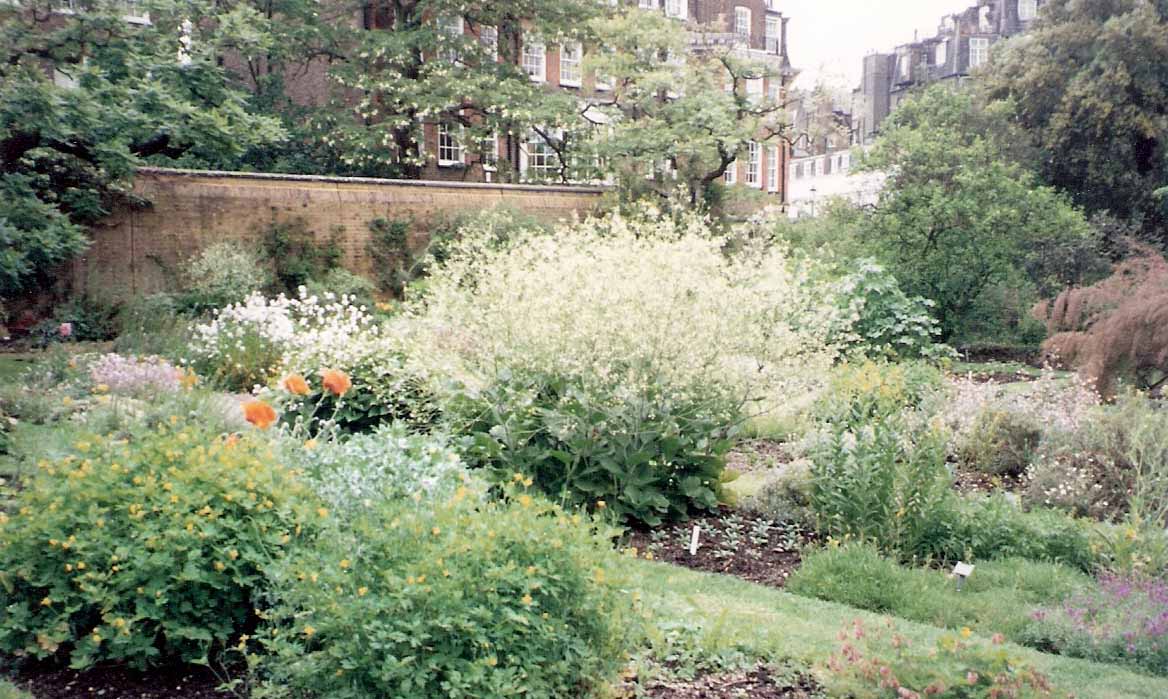
After the hubbub and excitement of the Chelsea Show it was a great relief and surprise to be able to walk just a short distance and find ourselves in another time and place. Tucked behind high walls in southern London we found the Physic Garden, a collection of over 5,000 plants dedicated to the science of healing. Founded in 1673 by the Worshipful Society of Apothecaries of London, the garden has always been planted with rare medicinal plants and herbs that can be used to treat all manner of human illnesses. Back in the late 1600s the garden gained a benefactor,Sir Hans Sloane, who set an annual rent of 5 pounds (approximately $10 U.S.) for the Physic Garden so long as it maintained its pharmaceutical mission, payable from his estate even to modern times! Here he guards his investment:


Keeping in mind that there are over 5,000 plants growing in a small city space, the garden beds were laid out geometrically with narrow grass walking paths between the beds--narrow enough so that the visitor could see the precise labeling of each plant:

Invasive plants such as mint or those that grow from underground runners were cleverly planted in clay, bottomless pots and then sunk in the ground:
This is a white and pink variety of the Seven Sister's Rose, which is several hundred years old:
This ancient wooden greenhouse protects tropical and sub-tropical plants that are too tender for London winters. It also houses a tea shop where we enjoyed a good cup of English tea and scone with clotted cream:Every bit of space was planted, including a waterway for reeds and, look closely for the ducks:

If you look over the wall you can see the busy London traffic rushing by. Amazing that the Physic Garden exists in all its medieval glory in the middle of a modern city:
After a day of total plant absorption, a few members of the tour group and I enjoyed a Greek dinner of souvla (grilled lamb and potato), Greek salad, and baklava. We ended the evening with a late night stroll through Piccadilly. Tomorrow morning we're on the bus early, traveling into East Sussex to see grand castles and estate gardens and natural forests where azaleas and rhododendrons were in full bloom. Check back next week for leg three of the English Gardens tour.

Tuesday, June 14, 2011

Teaser Tuesday - The Ice Princess by Camilla Lackberg


Fans of Scandinavian crime fiction/police procedural writers such as Stieg Larsson (Girl with Dragon Tattoo trilogy) and Henning Mankell (Kurt Wallander mysteries) may appreciate a feminine voice in this very popular genre. Camilla Lackberg adds this perspective in The Ice Princess, set in Fjallbacka, a once thriving fishing village in northern Sweden since the 1800s. Now the town is a favorite tourist destination and Lackberg's hometown.

Teaser Tuesday is described by its host, Miz B over at Should Be Reading ,as a "weekly bookish meme" open to any reader who wants to play along. If, like me, you're always curious about what people are reading or on the lookout for the next great read, then this may by your meme. To play, just click on Miz B's link above for the simple rules.


The Ice Princess
by Camilla Lackberg

"Erica hadn't been in this house for a long time, but she had once known it well, and she knew where the bathroom was. She shivered in the cold despite her warm clothing. The door to the bathroom swung slowly inward, and she stepped inside." p. 8


Book Description: Writer Erica Falck leaves her life in Stockholm on hold temporarily to return to her hometown Fjallbacka. Erica's parents had recently died in a car accident and now she and her younger sister must settle their parents' estate.

Immediately, on arrival in Fjallbacka, Erica is faced with the shocking discovery of her childhood friend Alex, dead of an apparent suicide. The writer in Erica senses that something is not right. She teams up with local police detective Patrik Hedstrom. They uncover shocking evidence of dysfunctional families, adulterous affairs, domestic violence and other secrets set against scenes of domesticity in this tranquil fishing village. The sins of the fathers--and mothers--destroy the lives of the present generation. Who must answer for these crimes?

Monday, June 13, 2011

Fun Monday - Signature Dishes


Sayre over at Sayre Smiles continues as our Fun Monday host for June. Her assignment for June 13: share descriptions and/or recipes for our signature dishes. If there's a celebration or party, what dish do the attendees beg you to bring? Or, what do you like to cook to share with others?

Sayre, I used to be a serious cook, but not any more. Usually the rare time I go to someone else's home I'm good for dessert--purchased at the Homemade Pie and Ice Cream Kitchen. One thing that I'm moderately famous for is combining chocolate and creme de menthe liquor. Many years ago I made this chococate cake flavored with creme de menthe, filled with a green creme de menthe frosting, topped with dark fudge frosting and decorated with rows of Andes mint triangles--very fancy.

These days I'm into less complicated. Recently I was invited to "audit" a friend's book club. My ticket in was a pan of Paula Deen's Creme de Menthe Brownies. They were a big success and very easy to make. Here's how:

Creme De Menthe Brownies
From Paula's Home Cooking/Celebrates/Nov/Dec 2005 issue

Ingredients

Shaved Creme de Menthe thins (recommended: Andes Creme de Menthe thins)
1 (10-ounce) package Creme de Menthe baking chips (recommended: Andes)
1/2 teaspoon baking powder
3/4 cup unsweetened cocoa
1 teaspoon vanilla extract
1 1/4 cup all-purpose flour
2 cup sugar
4 large eggs
1 cup (2 sticks) butter, softened
Chocolate frosting, see recipe below

Frosting:
1/2 cup (1 stick) butter, melted
1/3 cup cocoa
2 cups sifted confectioners’ sugar
1 teaspoon vanilla extract
2 tablespoons milk

Directions

Preheat oven to 350 degrees F. Grease a 13-by-9-by-2-inch pan.

Using an electric mixer, combine butter and sugar in a large mixing bowl; beat at medium speed until creamy. Add eggs, one at a time, beating well after each addition. Add vanilla, mixing well.

In a separate bowl, combine flour, cocoa, and baking powder. Gradually stir into butter mixture. Fold in mint chips. Spoon into greased pan. Bake for 35 minutes.

While brownies are baking, prepare frosting. Combine butter, cocoa, confectioners’ sugar, vanilla and milk in a large mixing bowl; beat at medium speed with an electric mixer until dry ingredients are moistened. Beat at high speed until spreading consistency.

Remove pan from the oven and allow brownies to cool in pan on wire rack. Spread with chocolate frosting. Top with shaved mint thins.

24 Servings

Be sure and check out other Fun Monday players, especially if your're looking for inspiration in the kitchen!

Friday, June 10, 2011

English Gardens Travelogue - In and Around London

This past month I've had only limited internet access since my home computer crashed. It has been annoying, but I have to admit to a couple of silver linings as well. In the process of de-cluttering and organizing stuff, I ran across some travel journals and photo albums of almost over two decades of travel for education and fun. Many of my trips to other countries focused on gardening because for many years that, along with dogs, was a great passion.

Many of the garden tours I took were sponsored by Horticulture Magazine in Boston. Beginning in the early 90s Horticulture teamed with gardening groups and societies from all over to sponsor tours of great public and private gardens. Several were led by Nan Sinton, a transplanted Irishwoman who worked and taught horticulture and garden design in the Boston area. In '93 I joined Nan for the first of several tours. Destination: Southern England, The Cotswolds, & London Including Chelsea Flower Show. In the couple of hours a day when the temps are below 90 degrees, I thought you keen gardeners may enjoy seeing some photos of the best of English Gardens.

So, I saved my pennies for a year, put the dogs in a nice kennel, and flew off to London to learn about English gardens and meet some truly gifted plant lovers of all ages. For the first three nights of the tour we had the Park Lane Hotel in Picadilly (photo above) as our base of operation. Notice the window boxes that combine flowers, trailers, and miniature evergreens. A first example of English gardening.

After the overnight flight from Boston to Gatwick I was too excited to crash in my nicely appointed room--especially appreciated the kettle and tea tray with English biscuits, and the pants press. The hotel was perfectly situated for some on foot exploring. Just out of the front door I headed across this great commons area, St. Stephen's Green (I think):

Just on the other side of the green, I ran across the Queen's digs. Yes, Buckingham Palace was within walking distance of our hotel and I just happened to catch the changing of the guards:
There was all manner of horsemen around including these showing uniformed police on crowd patrol in front of Buckingham Palace:
After an afternoon of exploration on foot, I met my tour group of about 25 gardeners back at the hotel for a Welcome Dinner, which, according to my journal, included some firsts for me: a terraine with asparagus, watercress soup. and lemon souffle. One thing you want to do on these kinds of trips is to find you a buddy, especially if you travel alone like me. You quickly discover people who share your interests, sense of humor, etc. I made plans with a mother-daughter duo to get tickets for Phantom of the Opera in its original run at the Queen's Theater for the second night we were in London. We sat in a second tier box and looked down on the stage. Very cool.

The morning of our second day in London we enjoyed a guided tour of the city with stops at all the famous points of interest including London Bridge, St. Paul's Cathedral, Big Ben. Trying to look at things with a gardener's eye, I spotted these simple, but lovely, window boxes--cinerara (I think):In the afternoon we headed to the Royal Botanic Gardens Kew for a walking tour led by one of Kew Garden's horticulturists. I saw examples of gardening techniques that before I'd only studied in magazines and books. Here's a sampling:


Apparently every gardener at Kew has his or her own tools. Here's Arv West's--including the handmade twig broom to sweep the grass--no kidding!


Arv probably used his extra sharp spade to cut these precisely shaped rosebeds. Not a trace of powdery mildew, black spot or insect damage to be found on these young bushes:


This long beech allee led to Kew Palace, site of a 17th century garden, herbals and lilacs:

In the new Princess of Wales Conservatory were saw amazing plants like the New Zealand tree ferns (on another Horticulture tour to New Zealand I saw these giants growing in the wild.):

And this was my first time to see an English formal walled garden with tall clipped hedges, mixed long borders edged with box, hard structures like the gazebo and iron sculpture, mature trees in the background:
One of the many gates leading into Kew Gardens. This is a formal planting of sweet william--notice the skillful melding of all the shades of red:

When I pick up this travelogue later in the week we'll finish with London and head south into Sussex and the Cotswolds. Pull on your gardening boots and join me!